Friday, February 4, 2011

Virtual Real Estate


Last night he finally caught up with me: the aerial photography salesman. He’d been over a few days before and chatted up the kids (which is a no-no, by the way), and promised to return again. And so he did.

Now, I need to say right up front that I am generally a sucker for pictures of my farm, especially when they are from unique angles, like looking down from a plane. I did, in the past, buy one of these pictures, a 1952 aerial shot showing the farm during it’s operating years, compete with a full array of outbuildings that have now vanished into concrete foundation shapes that haunt the lawn. It was black and white, and they offered to colorize it anyway I liked. Well – I liked it black and white and bought the smaller version in the wooden frame. Yes, these pictures come fully framed and printed in some sort of permanent laminated form so incredibly durable that they can even withstand being directly spattered with bird poo. Not making that up, the salesman actually used that as a selling point. Who could argue with that? So, about ten years ago, I became the owner of a piece of history.

But do I really need a second one? This year’s salesman thinks so. The new shot is a view of my farm from the backside, taken last summer when the corn was in full bloom surrounding the property on three sides. It shows all the satisfying angles of my folk Victorian farm house, along with a pretty view of my flower beds. Proudly producing the large glossy sample of my wonderful 2 and ¾ acre remnant of a farm, he began extolling the features. It was a nice shot, other than all the flaws that make a house a home.

While the yard was nicely mowed and their was no junk cars in the barnyard (anymore), there was a lot of other metal odds and ends lying out that I was in the determined process of purging. My ex-husband's left behind junk. Eighteen years worth of obsessive compulsive trash gathering with a pick up truck doesn’t disappear overnight, and he certainly didn’t take it with him. When I shelled out the big bucks to begin to repair the barn two years ago, it was time to restore it's dignity in and out, so out the junk went. My poor barn, having suffered years and years of neglect by the oppressive ex, finally began down the road of restoration and healing.


Now my beautiful sweet barn, which got one side (and one half of the roof) remade into classic barn red, happens to have three sides of classic weathered white. This looks quite odd in the picture, especially since the colors in these aerial photos always seem to me to be a surreal abstraction of anything found in nature. The red side of the barn is crazy red and is the focal point of the picture. The green of the yard and corn fields is an amazing bright green, like after the largest thunderstorm imaginable has just passed and teased out all the chloroplasts in the plant fibers.

As I begin to notice and comment on the colors and the barn, the salesman hits his stride. Ah – he tells me – it can be fixed! I can easily change the colors in the picture, he brags. As a matter of fact, with the simple request on the order form, I can get the whole barn finished. All red, all done. Not even costing me the 20,000 that the real job would. And I could change the shade of red. And erase the garbage. As he begins to find what he thinks are my objections to the quality of the photo, he starts making more suggestions, which range from other exterior virtual painting of buildings and roofs, to moving buildings, and finally (not kidding here) to adding a spaceship in the corner. As this older gentleman, from the era of door to door sales, proceed to emphatically describe “photoshop” techniques like they were just invented last week, he loses me.

Maybe it is my scientific formation that recoils at the blurring of truth. Or maybe it is my emotional demand for authenticity that can’t tolerate photofakery. I am now four and a half years into this adventure called divorced single mother hell, and I do not believe in short cuts. Or virtual fictions of the way I wish my life looked.


My broken divorced self, having spent all this time doing the hard work of restoring what was destroyed and neglected, can’t accept the false vision of how it should all look. When it does look perfect it will be because it is perfect. Facades are gone in my life – well as much as can be for now – they are shattered. I have little interest in faking things that are not so, even if the fake is hard, durable, and can withstand the spattering of bird poo.

Did I tell him all this? No. Seeing that he wasn’t going to close the deal, he offered to come back at a different time, maybe when my husband was home. Yes, come back then.

Monday, August 9, 2010

Path to Page Workshop Part 4


Recently, I went on a day long hiking and writing workshop in the Sleeping Bear Dunes National Lakeshore in Northern Michigan. The class was lead by Ann-Marie Ooman and sponsored by Preserve Historic Sleeping Bear, the park liaison group that coordinates volunteer efforts to maintain the historic buildings on the park grounds.
The hike went through the Port Oneida Historical District, which contains unoccupied homes, barns, beautiful forests and breathtaking views of Lake Michigan.
The following is an excerpt from one of my writings that day, in its first draft form.


Port Oneida Schoolhouse

Prompts:
1. Once...
2. I remember...
3. I dreamed...
4. What I understand now...

Once, not that long ago, these doors were open everyday, letting in the neighboring children summoned by a bell to class. It was the hub of the community. Did the children like to be here? That would've depended on the comparative differences for each child between home life and school. What was the teacher like? They would've had him or her for several years until the teacher either moved on to a different district or married and abandoned the career altogether.
I remember the competitiveness of elementary and junior high, the value of proving myself outside of home and excelling among my peers. It was a place where girls really could compete, and even had the advantage. An advantage that evaporated quickly after college. These girls in Port Oneida would've lost that advantage earlier. While allowed to attend school up until maybe 8th grade, they would've had somewhat equal footing with the boys here. Vocational training at home would be very different based on gender expectations.
As a child, I dreamed of a limitless world, the stuff of Disney fables, where women are valued for substance. Their ideas appreciated and given equal footing.
What I understand now is that it was an illusion. Without the security of gender roles and stability of the family as a unit, more is expected of women with less reward. As child bearers and rearers, women are still a vulnerable population that need special considerations and protections. In our haste to control our lives as women, we have lost our natural biological selves. What Would Nature Do? It would extinct us for our errors.

Path to Page Workshop Part 3


Recently, I went on a day long hiking and writing workshop in the Sleeping Bear Dunes National Lakeshore in Northern Michigan. The class was lead by Ann-Marie Ooman and sponsored by Preserve Historic Sleeping Bear, the park liaison group that coordinates volunteer efforts to maintain the historic buildings on the park grounds.
The hike went through the Port Oneida Historical District, which contains unoccupied homes, barns, beautiful forests and breathtaking views of Lake Michigan.
The following is an excerpt from one of my writings that day, in its first draft form.


Werner Family Cemetery

It was holy. That's what the early settlers thought of the views of Lake Michigan. The Lake, with its sparkling blue and crashing waves, was ultimately a hold place. It was customary to bury family on a hill overlooking the property. Maybe a nod to a life well lived; forever smiling down on what was accomplished and watching over family? But here, here they are also within earshot of the waves, overlooking, now through trees, the vast expanse of blue - all the way to the horizon. Where the Lake meets the sky; a symbol of eternity. This is easily a place of rest.
What Would Nature Do? Nature, which can be of such danger and unpredictability, can also comfort and soothe.
This is a holy place. Not made holy by the presence of human remains on a blessed and hallowed piece of ground, but rather recognized as holy by fellow humans over 100 years ago. Recognized as a place that they chose to create monuments to their dead and put them back into the hands of God.
This is where I want to be, at peace in this natural place, hearing the conversation of God as He "hovers over the face of the waters" and splashes on the rocks of the shore below.
These are the things that refuel me, and give me the strength to do the things I need to do. Perfect quiet, perfect peace. So rare yet so vital.
So about here is where God caught up with us on the trail - or at least me. Feeling Him fully here, I can guess that the settlers felt Him too. Comfort and resignation at the burying of their dead. Whether it meant an increase in hardship at the loss or a blessed rest of a suffering family member, God came alongside them here, as He does me even now. This is a place of reflection. I wish I could capture the feeling here with a picture. I'm sure I won't.
It is warm with a slight breeze. Cicada are humming; waves are crashing. The ground is cool and dry. Branches crunch under step. Sunlight plays through the moving leaves. Time to go...

Path to Page Workshop Part 2


Recently, I went on a day long hiking and writing workshop in the Sleeping Bear Dunes National Lakeshore in Northern Michigan. The class was lead by Ann-Marie Ooman and sponsored by Preserve Historic Sleeping Bear, the park liaison group that coordinates volunteer efforts to maintain the historic buildings on the park grounds.
The hike went through the Port Oneida Historical District, which contains unoccupied homes, barns, beautiful forests and breathtaking views of Lake Michigan.
The following is an excerpt from one of my writings that day, in its first draft form.


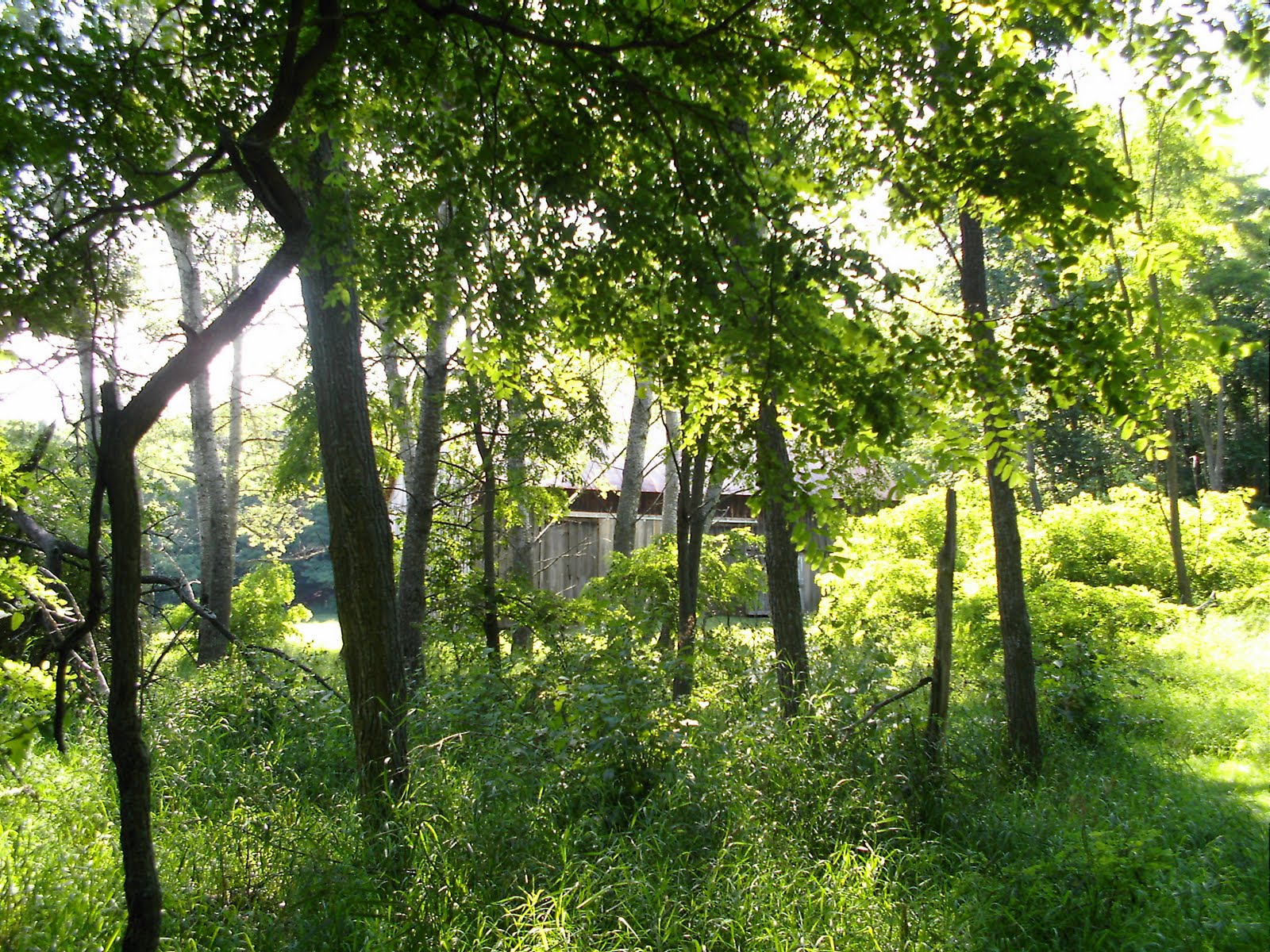
Miller Barn
Birds, leaves rustling in the breeze, sounds of distant traffic. Stillness of the barn. It rests easily and comfortably on its property. The house is gone, first from fire, then from neglect, but the barn remains - still and strong. It is on a firm foundation of stones - the huge corner posts resting flatly on boulders. This is an easy place to be, the site is at rest.


Earlier I wondered what the people who lived here thought of life on the edge of Lake Michigan, with its dramatic views and fierce weather. Were they afraid, awestruck when they looked out on the larger than life landscape? I often feel that way, overwhelmed by the otherworldly sights here. But 125 years ago, when their lives depended on the elements, how much more amazing it would've been to see the Lake, on it's beautiful days as well as it's stormy ones. With all of the modern control I have over my world, looking out onto the dunes and Lake still makes me feel small.
Yes, they were terrified - unable to control the elements, like the cold and snow of winter and storms, they had to always be prepared - to accept whatever came on a daily basis. Their coping mechanisms were not developed like ours are - a/c, furnace, radar to track storms, snow plows, and good cars. Every change had the potential to be a huge upset; every storm could destroy, like a roof blown off a barn.
In the Olsen house nearby, there is an interpretive display about life on an early farm, which talks about the daily drudgery of the "wood chores". If they didn't do wood chores daily in the winter, there would be no cooked food, no warm house, no warm water. They are wrong about the wood chores. Wood chores, no mater how laborious, create the end result of incredible warmth. It is a miracle in the dead of winter to enjoy the warmth of a fire. Having lived a winter season in an old drafty farm house can create the appreciation of heat on a bitterly cold night. It is the kind of heat that warms to the bones. It is an enormous blessing, universally enjoyed and appreciated by every living thing in the house.

From Anne-Marie Oomen's writing, "When its work is done, a barn knows how to be alone...it knows how to close its eye; it does not long for callers."
Yes, old barns really know how to be empty, when they are solidly cared for and sturdily made. Old homes do not know how to be empty - a sadness resonates in them and reverberates outward onto their sites, and can be felt in a passing car - even at 55 mph. Old homes, without the flow of story, are unable to stand, and start to become invaded by weather and animals. What Would Nature Do? It would erase all traces of human past.
Why? Why are we so much a part of the natural world, yet so far from it? Why are we at war with it?
This site, at the Miller Barn, is a site at rest. Nature and humans have struck a balance here, allowing for serenity to pervade the very rocks of the foundation.

Tuesday, August 3, 2010

Path to Page Workshop Part 1


Recently, I went on a day long hiking and writing workshop in the Sleeping Bear Dunes National Lakeshore in Northern Michigan. The class was lead by Ann-Marie Ooman and sponsored by Preserve Historic Sleeping Bear, the park liaison group that coordinates volunteer efforts to maintain the historic buildings on the park grounds.
The hike went through the Port Oneida Historical District, which contains unoccupied homes, barns, beautiful forests and breathtaking views of Lake Michigan.
The following is an excerpt from one of my writings that day, in its first draft form.


Prompt: “The wilderness is within walking distance…”
…And beyond that the calm of the lake, where the “spirit of the Lord is hovering over the face of the waters.” (as in Genesis 1), then more wilderness – in the form of an island. Aren’t all wildernesses islands? Ever shrinking spaces in our haste to control the world? Often we’d like to think so, but then the wilderness escapes.
“What Would Nature Do?” as I saw on a t-shirt yesterday in a local gift shop. Interesting theology, meant to somehow evoke trust in nature and raise it to the form of deity. Bad news is that Nature would very likely kick your ass and not think twice. “Nature” isn’t interested in our best interest as humans, and while we have certain evolutionary advantages, like thumbs and larger brains, we are on our own in the natural world. Self preservation, in and of itself, is completely natural.
Wilderness is always within walking distance, but the truth is that it is walking up on us – ever stalking and sneaking in- seeking its own end. If you’ve ever attempted to garden, you’ll recognize this fact – especially if you have a fondness for controlled, tidy beds. Nature is certainly not tidy, and wields its own beauty in its very unpredictability and awe evoking power. It is a system set into play with its own rules and its own sense of truth, much unknowable. While we can “know” the biology, botany, meteorology and other parameters of nature, we can’t know them in the sense of accepting and letting go of the control and predictability we want. This space, this park, is about conceding the desire to rule, stepping back, setting a truce, watching and waiting. And, as the spirit of the Lord hovers over the waters, if we are still, we may connect to it.

High on this hill, overlooking Lake Michigan and the surrounding farmlands and the Manitou Islands, what did people think of this view one hundred years ago? Would it be more or less awe inspiring?

Tuesday, June 15, 2010

Running

Last year, at the age of 40, I began to run. Why? Well, maybe the first clue is easy to spot: I turned 40. It wasn't just that, it was actually a lot of things. Over the past four years, having escaped marriage in to the serenity of divorced life as a single mom (yes I did say serenity), I expected certain goals would be met by my 40th. I really had my dial set for 40, no farther. Four years was plenty of time to heal, recover financially, get the kids settled into this new reality, and who knows - maybe even have a tidy relationship with a boyfriend on the side. For a while, all was falling into place, operating under the power of my own steam, along with the help of others, was really working. Along the way, the shine began to wear off of my acomplishments, my momentum slowed, and life got very - well- 'daily'. Slower than daily actually.
And then I fell down the stairs. In my fuzzy socks hopping down my wooden stairs, turning to pick up a discarded toy, I lost my grip on the floor and twisted at the knee in one unnatural electrically jolting movement while I crashed into the livingroom. It took eight months of ignoring it to get to the point where I realized it wasn't gong to fix itself, and four more to get the surgery I needed. The motivation to move followed quickly on the heals of four weeks on crutches. Physical therapy went well, and I harnessed the momentum toward wellness into a running program.
This spring, I ran in the Riverbank Run in Grand Rapids, my first time ever in any kind of race. 21,000 runners were there that morning to participate in one of the races, mine was the 5K. While 5K may not sound far, it is after all only 3.1 miles, it was the longest I had ever run. I was very insecure about how I might perform that day. Would I make it? Would I have to walk? Would every other person pass me? Would I freeze to dealth with forcast rain in the low 40's? None of my fears were valid and after 5 months of training, the race felt like a victory lap. Every step of it.
Am I a runner? Yes. Because I run, and I have found my momentum again.

Tuesday, February 23, 2010

Fertility Q & A - When to Start Trying to Conceive, Delaying Fertility, and When to Start Treatment.

Q: I'm 34 and want to wait a year or two to try to get pregnant (I just got married and want to enjoy our new status!) Will my chances to get pregnant change dramatically in that time period, or stay the same as they are now?
A: Congratulations on your marriage! There are certainly a lot of changes in your life right now, and even good changes need time for adjustment. Family-planning often follows closely on the heels of the big event, making you (and your spouse) wonder if you are moving too quickly.
Taking all things into consideration, you have to stop and listen to the ticking of your biological clock. It is a fact of nature that after the age of 35, egg quality starts to decrease significantly in women. While it is true that women get pregnant after age 35 all the time, it is more challenging due to changes that occur in the eggs chromosomes and the biochemical make up of the cell. Beginning to try to conceive at age 34 is biologically better than waiting until you are 36. It is certainly possible that you will get pregnant at age 36 with no trouble at all. The problem is that you won't know until you try.
In this day of female independence, many women are offended to hear that at age 35, their eggs are "old". The reality is that we are naturally designed to have our children young; much younger than we are often socially and financially ready to. You and your husband may find it more important as a couple to wait a few years, just make sure you are making an informed decision.

Q: Is it common for women to freeze their eggs for use at a later date, and does it typically work?
A: Egg freezing is an attractive possibility for a few reasons. Single women could store eggs well ahead of menopause to prolong their child-bearing years. Cancer patients could insure their reproductive abilities by saving eggs in the deep freeze ahead of cancer treatments that often damage them. And of course, the most ethically significant reason: the dilemmas regarding frozen embryos would be avoided if the eggs and sperm could be successfully frozen separately. This would eliminate the painful decisions of what to do with unused frozen embryos.
The reality of the matter is that the technology for freezing eggs is still experimental and relatively unproven. It is starting to become commercially available at select clinics around the country, but I would recommend that women do their homework first. The human egg is very fragile and generally does not survive freezing well. Understand that the take home baby rate per thawed egg is extremely low. The younger the woman is when she freezes the eggs, the better the possibility of a pregnancy later. No one should rely entirely on this method for reproduction at this time. Eventually, as the scientific technique gets better, this may become more mainstream medical care.

Q: How long should I try to get pregnant on my own before seeing an Infertility Specialist?
A: If you are a woman under 35, specialists recommend that you seek assistance after 12 months of unprotected intercourse without pregnancy. If you are over 35, don't wait longer than 6 months. Egg quality changes drastically after age 35, and every cycle counts.
If you want to be proactive and work toward conception without the wait, I suggest an at-home fertility product, such as the Conception Kit. It is a great way for people to take charge of their fertility, and get a jump start on trying to conceive. Often, men in particular are reluctant to see the doctor, knowing that it will involve the possibility of a semen analysis. Using an at-home product can help get started without the pressure of an office visit, easing your partner into the process, while still working toward your goal of building a family.

Sources:

1. http://www.asrm.org/Patients/patientbooklets/agefertility.pdf
2. http://www.asrm.org/Media/Practice/Essential_elements.pdf